ThirdHome: Member Onboarding

OVERVIEW

Redesigned the new-member onboarding experience for ThirdHome, a private travel platform where owners of luxury second homes exchange stays at other high-end properties around the world. The project focused on simplifying the onboarding journey for homeowners joining the exchange network while ensuring that homes met the platform’s quality standards.

YEAR

2023

ROLE

Senior Product Designer

CATEGORY

Onboarding • Conversion Optimization • Two Sided Marketplace

About the project

Getting someone to sign up is one thing. Getting them to list a luxury second home, understand a credit-based exchange system, and trust the platform enough to actually participate? That’s a different game.

At ThirdHome, onboarding wasn’t just about creating an account—it was about bringing high-quality inventory into a two-sided marketplace (aka: no homes = no trips = no business). The opportunity was to turn a pretty complex, slightly overwhelming process into something that felt clear, guided, and—dare I say—actually enjoyable.

Goal

Improve activation and reduce friction in the onboarding process by guiding new members through property submission, eligibility review, and profile completion—while reinforcing trust and exclusivity within a curated home exchange marketplace.

Challenges

Designing for a luxury audience sounds fun until you realize your users still need things to be… usable. I had to balance "luxury" with actually being usable. A big challenge was creating an experience that felt premium without becoming overly stylized or difficult to navigate—especially given the demographic skew (less “Gen Z speed-run onboarding,” more “take me step-by-step, please”). On top of that, accessibility issues were holding people back. So I focused on creating something that felt elevated but still familiar and easy to move through—because “luxury” shouldn’t mean confusing.

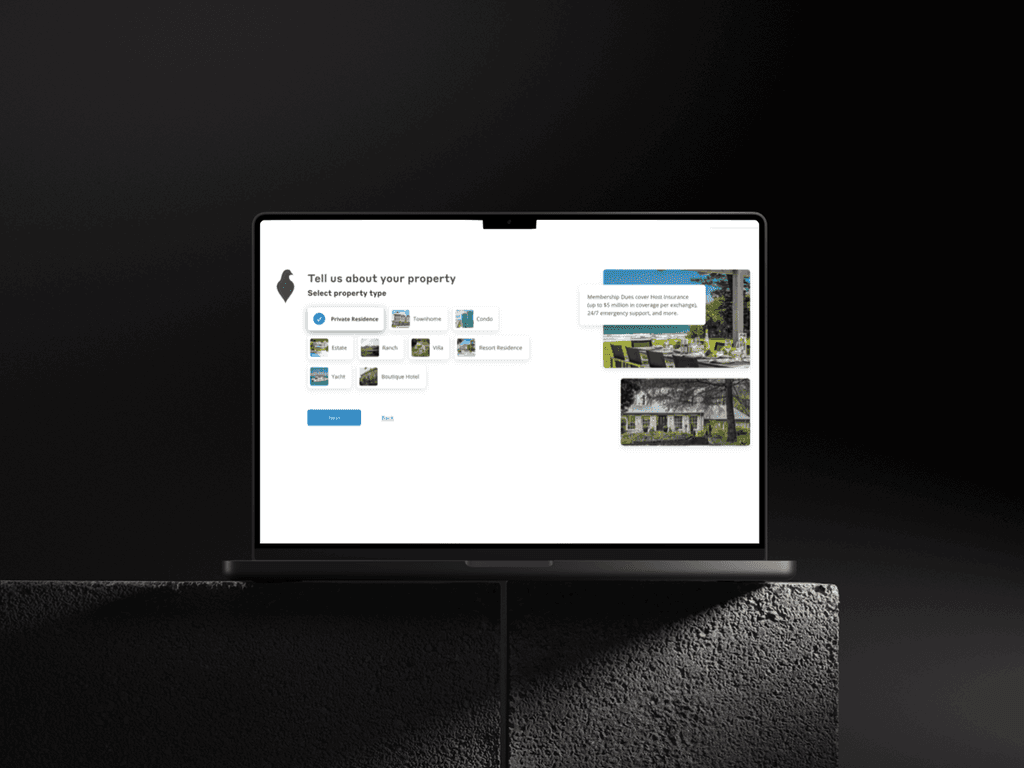
Another challenge was explaining a non-standard business model without losing people. ThirdHome doesn’t operate like a typical booking platform—there’s no straightforward “pay and stay.” Instead, it runs on a credit-based exchange system (aka: “Keys”), which required a bit of a mindset shift for new users. Translation: we had to teach users how the product worked while they were trying to complete onboarding. To solve this, I introduced lightweight educational moments—tooltips, contextual guidance, and progressive disclosure—so users could learn just enough at the right time without feeling like they were reading a manual.

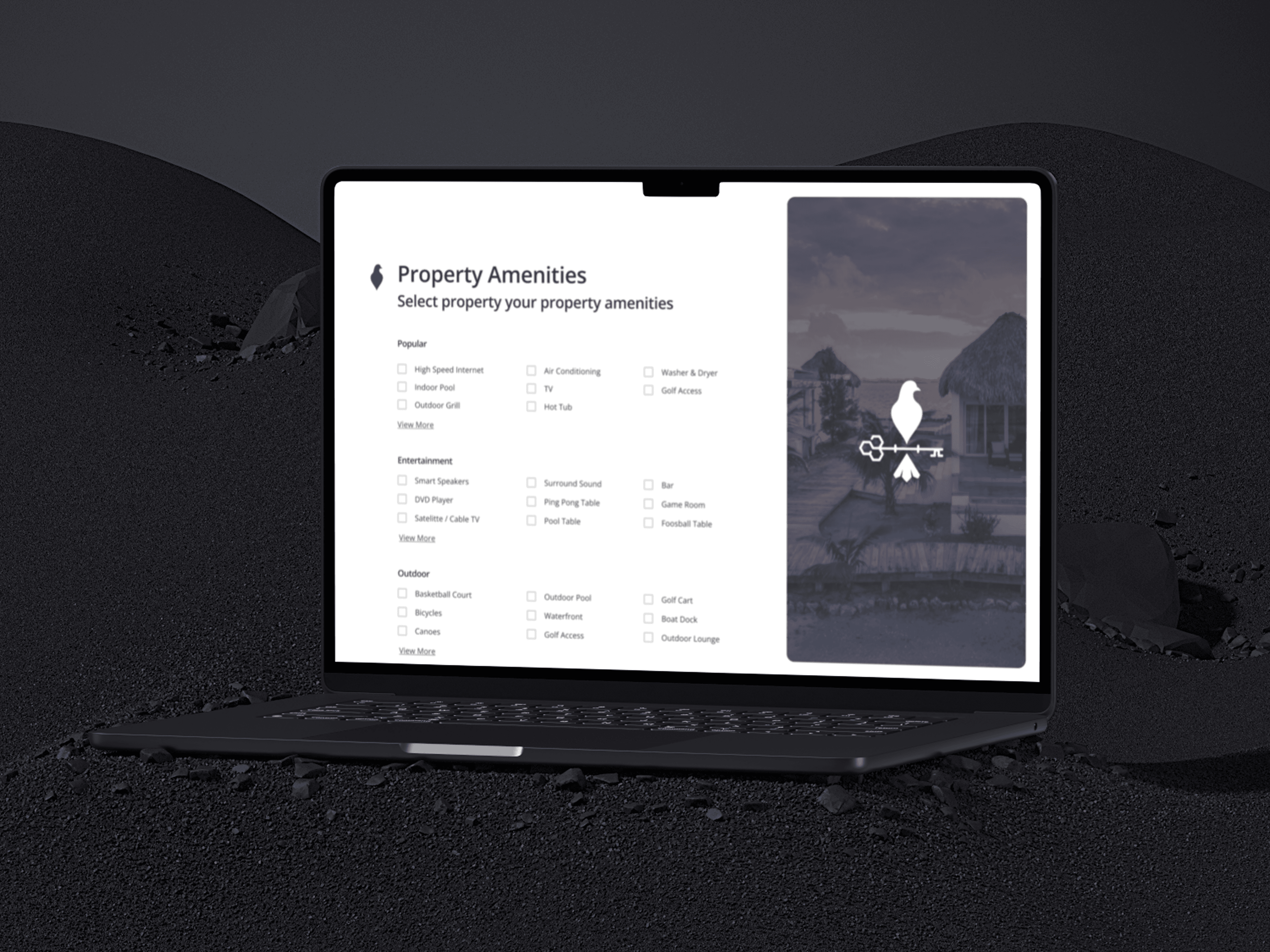
After meeting with the customer success team and sitting in on Membership Experience meetings, I realized we needed to collect detailed property info, photos, availability, eligibility criteria from users… basically everything required to maintain a high-quality inventory. The problem? That’s a lot to ask upfront from a new user. How do I collect all this information without feeling like a tax form? I restructured the flow into more digestible steps, introduced clearer progress indicators, and prioritized inputs so users didn’t feel overwhelmed. Behind the scenes, I also worked closely with internal teams (including Sales) to ensure the information collected actually supported downstream workflows—because onboarding wasn’t just for users, it needed to work for the business too.

This required coordinating a multi-step, multi-team process because onboarding didn’t end when the user clicked “submit.” There were multiple backend steps—property review, membership approval, exchange readiness—that needed to feel cohesive from the user’s perspective. I mapped the full end-to-end journey and designed states that kept users informed and confident throughout the process (instead of wondering if their home disappeared into a black hole). I also rolled this out as a controlled A/B test—launching to a subset of users first—so we could validate improvements before scaling.

Results

What I found was that onboarding wasn’t just a “new user” problem—it was a system problem. Once I clarified the experience, everything started clicking. We saw increased completion rates across onboarding and property submissions, along with a 3x+ lift in the acquisition funnel—meaning more qualified homeowners actually made it through the process. Drop-off during key steps like property listing and eligibility review decreased, and users had a much clearer understanding of how the exchange model worked (fewer confused emails = always a win). Internally, Sales and Operations teams also benefited—because the information coming in was more complete and usable, which made it easier to move prospective members forward. And the business impact? Within one quarter of tracking, the redesign contributed to ~$250K in increased revenue, proving that making onboarding clearer doesn’t just help users—it fuels the entire marketplace. Also, small win: we made a fairly complex, multi-step process feel… not painful. Which, honestly, might be the biggest flex.
Smooth Scroll
This will hide itself!

ThirdHome: Member Onboarding

OVERVIEW

Redesigned the new-member onboarding experience for ThirdHome, a private travel platform where owners of luxury second homes exchange stays at other high-end properties around the world. The project focused on simplifying the onboarding journey for homeowners joining the exchange network while ensuring that homes met the platform’s quality standards.

YEAR

2023

ROLE

Senior Product Designer

CATEGORY

Onboarding • Conversion Optimization • Two Sided Marketplace

About the project

Getting someone to sign up is one thing. Getting them to list a luxury second home, understand a credit-based exchange system, and trust the platform enough to actually participate? That’s a different game.

At ThirdHome, onboarding wasn’t just about creating an account—it was about bringing high-quality inventory into a two-sided marketplace (aka: no homes = no trips = no business). The opportunity was to turn a pretty complex, slightly overwhelming process into something that felt clear, guided, and—dare I say—actually enjoyable.

Goal

Improve activation and reduce friction in the onboarding process by guiding new members through property submission, eligibility review, and profile completion—while reinforcing trust and exclusivity within a curated home exchange marketplace.

Challenges

Designing for a luxury audience sounds fun until you realize your users still need things to be… usable. I had to balance "luxury" with actually being usable. A big challenge was creating an experience that felt premium without becoming overly stylized or difficult to navigate—especially given the demographic skew (less “Gen Z speed-run onboarding,” more “take me step-by-step, please”). On top of that, accessibility issues were holding people back. So I focused on creating something that felt elevated but still familiar and easy to move through—because “luxury” shouldn’t mean confusing.

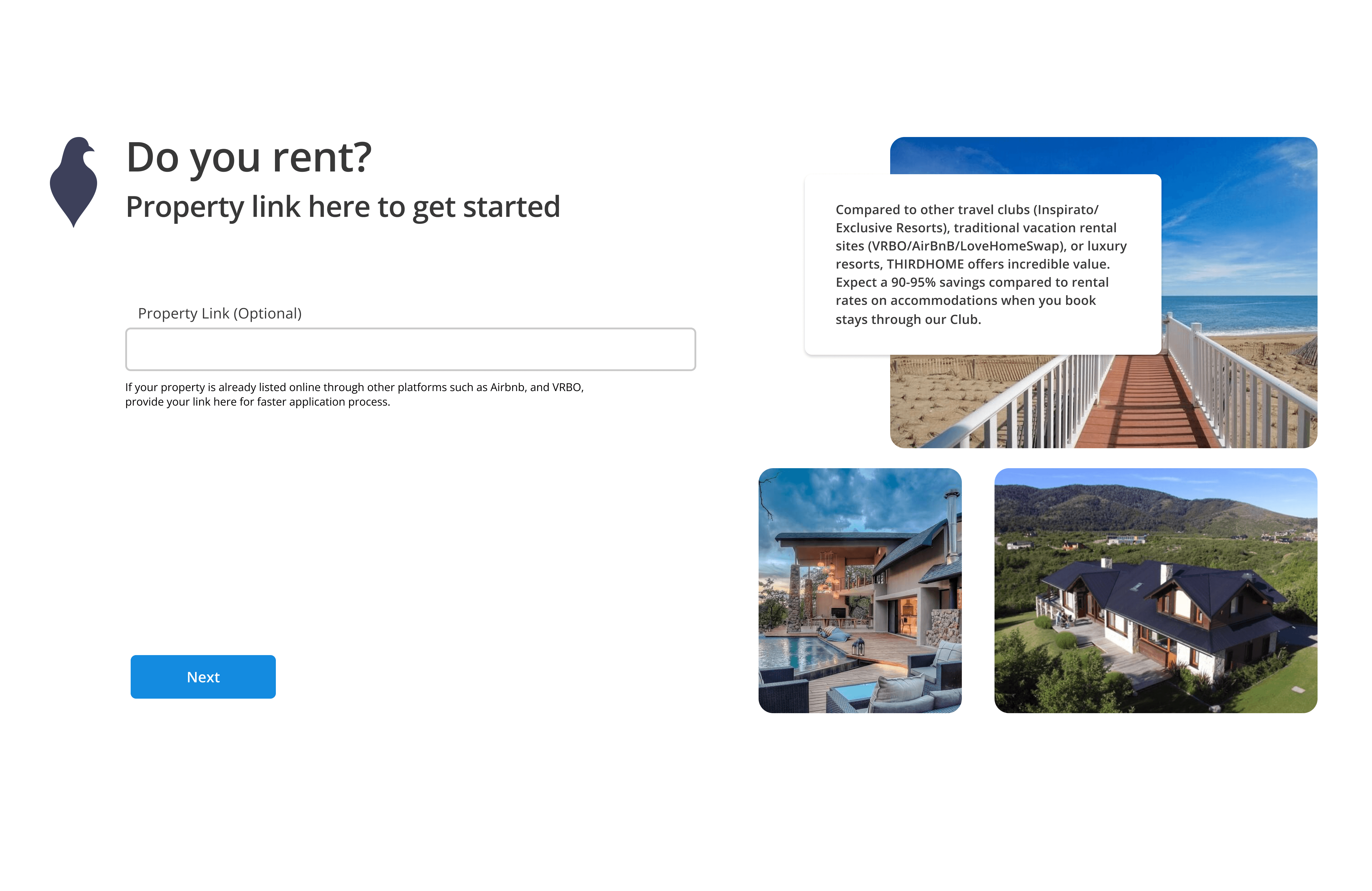
Another challenge was explaining a non-standard business model without losing people. ThirdHome doesn’t operate like a typical booking platform—there’s no straightforward “pay and stay.” Instead, it runs on a credit-based exchange system (aka: “Keys”), which required a bit of a mindset shift for new users. Translation: we had to teach users how the product worked while they were trying to complete onboarding. To solve this, I introduced lightweight educational moments—tooltips, contextual guidance, and progressive disclosure—so users could learn just enough at the right time without feeling like they were reading a manual.

After meeting with the customer success team and sitting in on Membership Experience meetings, I realized we needed to collect detailed property info, photos, availability, eligibility criteria from users… basically everything required to maintain a high-quality inventory. The problem? That’s a lot to ask upfront from a new user. How do I collect all this information without feeling like a tax form? I restructured the flow into more digestible steps, introduced clearer progress indicators, and prioritized inputs so users didn’t feel overwhelmed. Behind the scenes, I also worked closely with internal teams (including Sales) to ensure the information collected actually supported downstream workflows—because onboarding wasn’t just for users, it needed to work for the business too.

This required coordinating a multi-step, multi-team process because onboarding didn’t end when the user clicked “submit.” There were multiple backend steps—property review, membership approval, exchange readiness—that needed to feel cohesive from the user’s perspective. I mapped the full end-to-end journey and designed states that kept users informed and confident throughout the process (instead of wondering if their home disappeared into a black hole). I also rolled this out as a controlled A/B test—launching to a subset of users first—so we could validate improvements before scaling.

Results

What I found was that onboarding wasn’t just a “new user” problem—it was a system problem. Once I clarified the experience, everything started clicking. We saw increased completion rates across onboarding and property submissions, along with a 3x+ lift in the acquisition funnel—meaning more qualified homeowners actually made it through the process. Drop-off during key steps like property listing and eligibility review decreased, and users had a much clearer understanding of how the exchange model worked (fewer confused emails = always a win). Internally, Sales and Operations teams also benefited—because the information coming in was more complete and usable, which made it easier to move prospective members forward. And the business impact? Within one quarter of tracking, the redesign contributed to ~$250K in increased revenue, proving that making onboarding clearer doesn’t just help users—it fuels the entire marketplace. Also, small win: we made a fairly complex, multi-step process feel… not painful. Which, honestly, might be the biggest flex.
Smooth Scroll
This will hide itself!

ThirdHome: Member Onboarding

OVERVIEW

Redesigned the new-member onboarding experience for ThirdHome, a private travel platform where owners of luxury second homes exchange stays at other high-end properties around the world. The project focused on simplifying the onboarding journey for homeowners joining the exchange network while ensuring that homes met the platform’s quality standards.

YEAR

2023

ROLE

Senior Product Designer

CATEGORY

Onboarding • Conversion Optimization • Two Sided Marketplace

About the project

Getting someone to sign up is one thing. Getting them to list a luxury second home, understand a credit-based exchange system, and trust the platform enough to actually participate? That’s a different game.

At ThirdHome, onboarding wasn’t just about creating an account—it was about bringing high-quality inventory into a two-sided marketplace (aka: no homes = no trips = no business). The opportunity was to turn a pretty complex, slightly overwhelming process into something that felt clear, guided, and—dare I say—actually enjoyable.

Goal

Improve activation and reduce friction in the onboarding process by guiding new members through property submission, eligibility review, and profile completion—while reinforcing trust and exclusivity within a curated home exchange marketplace.

Challenges

Designing for a luxury audience sounds fun until you realize your users still need things to be… usable. I had to balance "luxury" with actually being usable. A big challenge was creating an experience that felt premium without becoming overly stylized or difficult to navigate—especially given the demographic skew (less “Gen Z speed-run onboarding,” more “take me step-by-step, please”). On top of that, accessibility issues were holding people back. So I focused on creating something that felt elevated but still familiar and easy to move through—because “luxury” shouldn’t mean confusing.

Another challenge was explaining a non-standard business model without losing people. ThirdHome doesn’t operate like a typical booking platform—there’s no straightforward “pay and stay.” Instead, it runs on a credit-based exchange system (aka: “Keys”), which required a bit of a mindset shift for new users. Translation: we had to teach users how the product worked while they were trying to complete onboarding. To solve this, I introduced lightweight educational moments—tooltips, contextual guidance, and progressive disclosure—so users could learn just enough at the right time without feeling like they were reading a manual.

After meeting with the customer success team and sitting in on Membership Experience meetings, I realized we needed to collect detailed property info, photos, availability, eligibility criteria from users… basically everything required to maintain a high-quality inventory. The problem? That’s a lot to ask upfront from a new user. How do I collect all this information without feeling like a tax form? I restructured the flow into more digestible steps, introduced clearer progress indicators, and prioritized inputs so users didn’t feel overwhelmed. Behind the scenes, I also worked closely with internal teams (including Sales) to ensure the information collected actually supported downstream workflows—because onboarding wasn’t just for users, it needed to work for the business too.

This required coordinating a multi-step, multi-team process because onboarding didn’t end when the user clicked “submit.” There were multiple backend steps—property review, membership approval, exchange readiness—that needed to feel cohesive from the user’s perspective. I mapped the full end-to-end journey and designed states that kept users informed and confident throughout the process (instead of wondering if their home disappeared into a black hole). I also rolled this out as a controlled A/B test—launching to a subset of users first—so we could validate improvements before scaling.

Results

What I found was that onboarding wasn’t just a “new user” problem—it was a system problem. Once I clarified the experience, everything started clicking. We saw increased completion rates across onboarding and property submissions, along with a 3x+ lift in the acquisition funnel—meaning more qualified homeowners actually made it through the process. Drop-off during key steps like property listing and eligibility review decreased, and users had a much clearer understanding of how the exchange model worked (fewer confused emails = always a win). Internally, Sales and Operations teams also benefited—because the information coming in was more complete and usable, which made it easier to move prospective members forward. And the business impact? Within one quarter of tracking, the redesign contributed to ~$250K in increased revenue, proving that making onboarding clearer doesn’t just help users—it fuels the entire marketplace. Also, small win: we made a fairly complex, multi-step process feel… not painful. Which, honestly, might be the biggest flex.

Smooth Scroll
This will hide itself!